Mastering Tennis Grips: A Foundation for Success
Introduction:In the dynamic sport of tennis, the grip you choose plays a critical role in shaping your game and determining your level of success on the court. The way you hold the racket directly influences your shot execution, power generation, spin potential, and overall control. From the classic Continental grip to the versatile Eastern grip and the extreme Western grip, understanding and mastering different grips is essential for any tennis player seeking to excel in the sport. In this chapter, we delve into the world of tennis grips, exploring their intricacies, advantages, disadvantages, and the key elements that contribute to their effectiveness. Whether you’re a beginner looking to establish a solid foundation or an experienced player aiming to refine your technique, this chapter will provide valuable insights and guidance on the art of mastering tennis grips. So, grab your racket, get ready to explore the grip spectrum, and unlock the potential to elevate your game to new heights.
#1 – Continental

Recognized for its precision and versatility, the Continental grip has been utilized by players across generations. In this chapter, we explore the intricacies of the Continental grip, highlighting its strengths, weaknesses, and its enduring relevance in modern tennis.
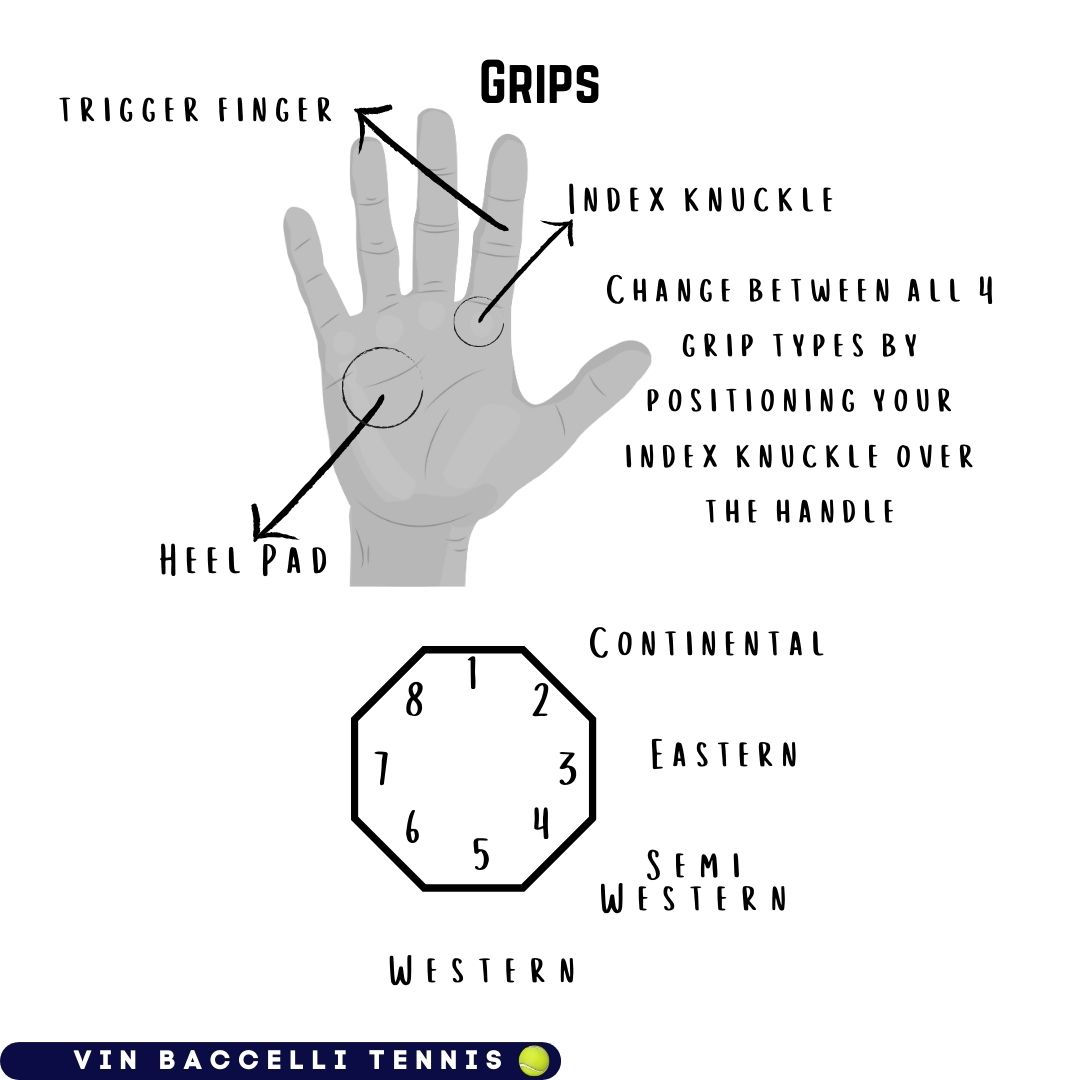
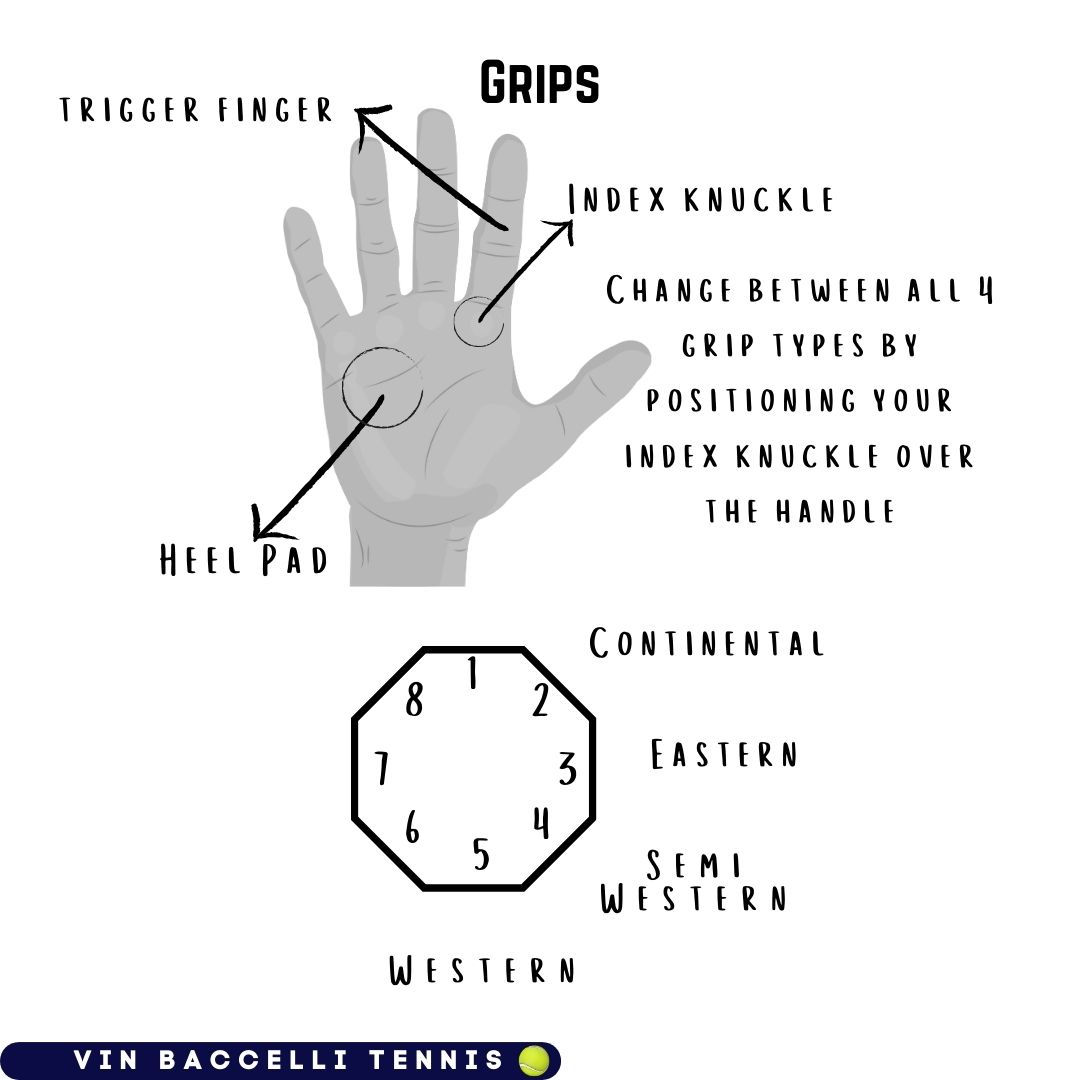
The index knuckle is positioned on the second bevel of the racket handle.
The Continental grip was the original and most commonly used grip when tennis was first introduced. This is because it allowed players to hit both forehands and backhands with ease, and it provided greater control over the racket. However, as tennis evolved and players began to hit with more topspin, grips like the Eastern and Western became more popular..
In modern tennis, the Continental grip is primarily used for volleys and serves. This is because the grip allows for greater control and precision when hitting volleys, as well as a greater ability to impart spin on serves. Additionally, the Continental grip can be used for defensive shots.
Overall, while the Continental grip may not be as widely used as it once was, it remains an important technique for volleys and serves.
Pros of the Continental Grip:
- Versatility Across Shot Types: The Continental grip is a versatile grip that can be used effectively for various shots in tennis. It provides a neutral hand position, allowing players to easily transition between different strokes, including volleys, serves, slices, and overhead shots. This versatility makes the Continental grip a fundamental choice for players who prefer an all-court style of play.
- Precise Ball Placement: With the Continental grip, players have excellent control over shot placement. The grip’s positioning, with the base knuckle of the index finger resting on the second bevel of the racket handle, promotes an upright and compact swing path, enabling players to direct the ball precisely to desired targets on the court. This precision is particularly valuable for players who rely on strategic shot placement to outsmart their opponents.
- Effective for Slice and Defensive Shots: The Continental grip is well-suited for executing slice shots and defensive shots with accuracy. The grip’s neutral hand position allows players to easily maneuver the racket face to impart sidespin on the ball, creating effective slice shots that stay low and skid off the court. Additionally, the Continental grip provides stability and control for defensive shots, allowing players to handle fast-paced shots and return them with depth and accuracy.
Cons of the Continental Grip:
- Limited Power Generation: Compared to grips like the Western or Semi-Western grips, the Continental grip may generate less power due to its more upright and compact swing path. Players relying heavily on power-driven shots may find the Continental grip less suitable for their style of play. However, with proper technique and adjustment, players can still generate sufficient power by utilizing body rotation and timing.
- Reduced Spin Potential: The Continental grip is not specifically designed to generate significant topspin. Players seeking to produce heavy topspin shots may find other grips more suitable. However, it’s important to note that the Continental grip can still generate moderate topspin, especially when combined with proper swing mechanics and technique.
- Adaptability to Modern Playing Conditions: The Continental grip has been a staple in tennis for decades, but its adaptability to modern playing conditions may be limited. With the evolution of court surfaces and equipment, which favor more topspin-oriented shots, players using the Continental grip may face challenges in generating the desired level of spin and adapting to the demands of the contemporary game.
The Enduring Relevance of the Continental Grip:Despite the emergence of newer grips, the Continental grip remains relevant and widely used in tennis. Its versatility, precise ball placement, and effectiveness in executing slice and defensive shots make it an essential tool in a player’s repertoire. The Continental grip offers a solid foundation for players to develop their game, providing the ability to adapt to different shot requirements and court conditions.
Additionally, the Continental grip is still prevalent in certain aspects of the game, such as volleys and serves, where its neutral hand position and precise racket control are highly advantageous. Many professional players continue to utilize the Continental grip for these specialized shots, highlighting its enduring relevance and effectiveness.
In conclusion, the Continental grip stands as a testament to its enduring relevance and versatility in tennis. While it may have limitations in power generation and spin potential, its precise ball placement and adaptability across shot types make it an invaluable grip for players seeking accuracy and versatility in their game. By mastering the Continental grip, players can unleash precision and control, adding a vital dimension to their overall tennis skills.
#2 – Estern

Renowned for its balance, consistency, and versatility, the Eastern grip has been favored by players of all levels for its reliability and adaptability. In this chapter, we delve into the intricacies of the Eastern grip, highlighting its strengths, weaknesses, and its enduring relevance in modern tennis.
The Eastern grip is widely regarded as the most complete and natural grip for groundstrokes in tennis. One reason for this is that it allows for a full range of motion when hitting both forehands and backhands.
imagine placing your hand open over the racket plate with your fingers spread apart. If you were to grip the racket with your hand in this position, you would naturally place your index finger along the third bevel of the racket handle
With your hand in this position, you are able to comfortably hit both forehands and backhands with a full range of motion. The index finger is positioned in a way that allows for a stable and consistent grip on the racket, while still providing enough flexibility to generate spin and power on your shots.
Overall, the Eastern grip is a complete and natural grip for groundstrokes in tennis.
Pros of the Eastern Grip:
- Solid Ball Control: The Eastern grip offers excellent control over the ball, making it a popular choice among players who prioritize consistency and precision. With the base knuckle of the index finger resting on the third bevel of the racket handle, the Eastern grip promotes a reliable and repeatable swing path. This grip allows players to strike the ball cleanly and accurately, facilitating consistent shot placement.
- Versatility across Shot Types: The Eastern grip is a versatile grip that allows players to execute a wide range of shots with ease. It is particularly well-suited for executing topspin groundstrokes, providing players the ability to generate consistent and controlled topspin. Additionally, the Eastern grip can be adapted for slices, flat shots, and volleys, making it a well-rounded choice for players who prefer a versatile playing style.
- Adaptability to Different Court Surfaces: The Eastern grip adapts well to various court surfaces, making it a reliable choice for players competing on different terrains. Whether it’s clay, grass, or hard courts, the Eastern grip provides players with the necessary control and versatility to adjust their shots effectively. This adaptability contributes to a consistent and well-rounded game, allowing players to compete at a high level across different playing conditions.
Cons of the Eastern Grip:
- Limited Power Generation: Compared to grips like the Western or Semi-Western grips, the Eastern grip may generate less power due to its more neutral hand positioning. Players who rely heavily on power-driven shots may find the Eastern grip less suitable for their style of play. However, with proper technique, weight transfer, and timing, players can still generate ample power using the Eastern grip.
- Moderate Spin Potential: While the Eastern grip allows for consistent topspin, it may not generate as much topspin as more extreme grips like the Western grip. Players seeking to generate heavy topspin shots may need to make adjustments in their swing mechanics and technique to maximize spin potential with the Eastern grip. However, it’s important to note that the Eastern grip still provides adequate spin for most players’ needs.
- Challenges with Extreme Angles: The Eastern grip may present challenges when attempting extreme angle shots or when stretched wide on the court. The grip’s neutral hand position may limit the ability to generate extreme angles, especially on defensive shots or when pulled out wide. Players may need to make adjustments or transition to different grips for these specific situations.
The Enduring Relevance of the Eastern Grip:Despite the emergence of more extreme grips, the Eastern grip remains highly relevant and widely used in tennis. Its solid ball control, versatility across shot types, and adaptability to different court surfaces make it a foundational grip for players of all levels. The Eastern grip provides a reliable and consistent foundation upon which players can develop their game and execute shots with precision.
Moreover, the Eastern grip is still prevalent in professional tennis, particularly for players who prioritize consistency and versatility over extreme power or spin. Many top-ranked players have achieved significant success utilizing the Eastern grip as the basis of their strokes, highlighting its enduring relevance and effectiveness.
In conclusion, the Eastern grip serves as a reliable and versatile foundation for players seeking consistency and control in their tennis game. While it may have limitations in power generation and extreme spin potential, its solid ball control, versatility across shot types, and adaptability to different playing conditions make it an invaluable grip for players of all levels. By mastering the Eastern grip, players can establish a strong and consistent game, laying the groundwork for success on the tennis court.
#3 – Semi Western

Renowned for its ability to generate both power and spin, the Semi-Western grip has become a favored choice among players in modern tennis. In this chapter, we delve into the intricacies of the Semi-Western grip, exploring its advantages and disadvantages, and shedding light on why it has gained traction in the contemporary game.
Pros of the Semi-Western Grip:
- Power and Spin Combination: The Semi-Western grip strikes a balance between power and spin generation. By positioning the base knuckle of the index finger slightly higher on the third bevel of the racket handle, players can achieve a moderate upward brushing motion while still maintaining the ability to hit flatter shots. This grip allows for solid power behind shots while providing sufficient topspin to control the trajectory and enhance consistency.
- Versatility in Shot Selection: One of the key advantages of the Semi-Western grip is its versatility across different shot types. With this grip, players can comfortably execute a wide range of shots, including topspin groundstrokes, volleys, and serves. The grip’s moderate topspin capability provides players with the option to hit penetrating shots with controlled depth or employ higher-bouncing shots to disrupt opponents’ rhythm.
- Adaptability to Various Court Surfaces: The Semi-Western grip adapts well to different court surfaces, making it a valuable asset for players competing on a variety of terrain. Whether it’s clay, grass, or hard courts, the Semi-Western grip allows players to adjust their shots effectively, handling variations in bounce and court speed. This adaptability contributes to a well-rounded game, enabling players to compete at a high level regardless of the surface.
Cons of the Semi-Western Grip:
- Moderate Spin Generation: While the Semi-Western grip offers a good balance of power and spin, it may not generate as much topspin as the Western grip. Players seeking extreme topspin may find the grip’s spin potential slightly limited. However, with proper technique and adjustment, players can still achieve a considerable amount of spin to effectively control the ball’s trajectory.
- Initial Adjustment Period: Switching to the Semi-Western grip may require an adjustment period for players accustomed to more traditional grips. The hand positioning and swing mechanics involved in the Semi-Western grip differ from grips like the Eastern or Continental grips. Players may need time to adapt their strokes and develop a consistent feel and timing with the grip.
- Vulnerability to Extreme Court Conditions: While the Semi-Western grip offers adaptability to various court surfaces, it may present challenges in extreme conditions. For example, on very fast and low-bouncing surfaces, the grip’s moderate topspin might not provide enough control, potentially leading to errors or difficulty in adjusting to the pace of the game.
The Popularity of the Semi-Western Grip:The rise in popularity of the Semi-Western grip can be attributed to its versatility and adaptability to modern playing conditions. As tennis surfaces have become more homogenized, with medium-paced hard courts being prevalent, players have sought a grip that combines power, spin, and control. The Semi-Western grip offers a middle ground, providing players with the ability to hit a variety of shots effectively, adjust to varying court surfaces, and adapt to opponents’ playing styles.
Additionally, the Semi-Western grip has gained traction due to advancements in racket technology. Modern rackets with larger sweet spots and string patterns have complemented the grip, enhancing its effectiveness in generating power and spin. These technological improvements have contributed to the grip’s increased usage among professionals and amateurs alike.
In conclusion, the Semi-Western grip has emerged as a versatile and adaptable tool in modern tennis. Its combination of power and spin, along with its versatility across shot types, makes it a popular choice for players seeking a balanced approach to their game. While it has its limitations in extreme conditions and may require an adjustment period, the Semi-Western grip offers players the opportunity to control the game with a diverse range of shots and adapt to different playing surfaces.
#4 – Western

Renowned for its ability to generate immense topspin, the Western grip has become a staple in modern tennis. In this chapter, we delve into the intricacies of the Western grip, exploring its pros and cons, and uncovering why it has become so widely used in the contemporary game.
Pros of the Western Grip:
- Enhanced Topspin Generation: The Western grip provides players with the unique advantage of effortlessly generating substantial topspin. By positioning the base knuckle of the index finger on the third bevel (V-shaped groove) of the racket handle, players can create an extreme upward brushing motion on the ball. This action imparts heavy topspin, causing the ball to dip sharply over the net and bounce higher, making it more challenging for opponents to counter effectively.
- Defensive Capabilities: The Western grip’s pronounced topspin enables players to defend against aggressive shots with greater control. When faced with powerful shots, the grip’s high net-clearing trajectory allows players to find depth and control, pulling their opponents deep behind the baseline and forcing them into uncomfortable defensive positions.
- Adaptability to High-Bouncing Surfaces: The Western grip has found particular favor on surfaces like clay and slow hard courts, where the ball tends to bounce higher. By harnessing the grip’s topspin capabilities, players can tame the high-bouncing balls more effectively, maintaining control and consistency in their shots.
Cons of the Western Grip:
- Limited Variety in Shot Repertoire: While the Western grip excels in generating topspin, it can limit players’ ability to execute certain shots, especially those that require flatter trajectories, such as low slices or flat drives. The grip’s extreme upward brushing motion can make it challenging to hit penetrating, flat shots, reducing the versatility of players who heavily rely on the Western grip.
- Vulnerability to Low Balls: The extreme upward brush of the Western grip makes it less suitable for handling low-bouncing balls. When faced with low shots, players using the Western grip may struggle to adjust their swing path to counter the lower trajectory effectively, potentially leading to errors or defensive positions.
- Steeper Learning Curve: Mastering the Western grip requires time, practice, and adjustment. The grip’s unique hand positioning and swing mechanics can take longer to develop and refine compared to more traditional grips like the Eastern or Continental grips. Novice players might initially find it challenging to adapt to the grip’s nuances and may experience a temporary decline in their overall game.
The Popularity of the Western Grip:The widespread adoption of the Western grip in modern tennis can be attributed to the evolution of the game’s playing conditions and equipment. The advent of slower court surfaces, particularly the prevalence of clay courts in professional tournaments, has necessitated a style of play that emphasizes heavy topspin. The Western grip’s ability to generate substantial topspin aligns perfectly with this demand, allowing players to dominate the game with powerful, high-bouncing shots.
Furthermore, the advent of modern racket technology, with larger racket heads and more forgiving string patterns, has complemented the Western grip’s effectiveness. These advancements have enabled players to harness the grip’s topspin potential more efficiently, resulting in a surge in its popularity among tennis professionals and enthusiasts alike.
In conclusion, the Western grip has emerged as a game-changing technique in modern tennis. Its ability to generate substantial topspin and adapt to specific court conditions has revolutionized the way the sport is played. While the grip comes with its limitations, its advantages make it an indispensable tool in the arsenal of any player seeking to dominate the game with power, control, and relentless topspin.
#5 – The trigger finger
The trigger finger, also known as the index finger, plays a crucial role in grip positioning and shot execution in tennis. It serves as a guide and reference point for finding the optimal grip on the racket handle, commonly known as the trigger finger placement. The trigger finger helps establish proper hand positioning and alignment, contributing to a player’s overall technique and shot consistency. Let’s explore the importance of the trigger finger in different grips.
- Continental Grip:In the Continental grip, the trigger finger is positioned on the second bevel of the racket handle. This placement aligns the hand in a neutral position, allowing for versatility and ease in transitioning between different shots. The trigger finger acts as a reference point, ensuring consistent grip placement and promoting precision in shot execution.
- Eastern Grip:With the Eastern grip, the trigger finger rests on the third bevel of the racket handle. This positioning facilitates the desired hand orientation for generating topspin and executing groundstrokes effectively. The trigger finger guides the hand placement, enabling players to consistently find the correct grip for generating power and spin while maintaining control.
- Western Grip:In the Western grip, the trigger finger typically aligns with the fourth bevel or even wraps around the bottom of the handle. This extreme grip requires the trigger finger to adjust its placement to accommodate the more pronounced grip orientation. By positioning the trigger finger correctly, players can maintain stability, generate significant topspin, and control the racket face angle for effective shots.
The trigger finger serves as a tactile reference point, allowing players to find their desired grip quickly and consistently. It helps establish muscle memory, ensuring that players consistently achieve the optimal grip for executing different shots. By placing the trigger finger in the correct position, players can maintain a stable and controlled grip throughout the stroke, resulting in improved shot accuracy and control.
Additionally, the trigger finger plays a role in generating kinetic chain movement. It acts as a trigger to initiate the kinetic sequence, transferring energy from the body through the arm and into the racket. The proper positioning of the trigger finger ensures efficient transfer of power and contributes to shot speed and effectiveness.
In summary, the trigger finger is a vital component of grip placement in tennis. It helps establish proper hand positioning, alignment, and muscle memory, contributing to shot consistency, accuracy, and power generation. By paying attention to the trigger finger’s placement and utilizing it as a guide, players can optimize their grip and enhance their overall performance on the tennis court.
Conclusion
In conclusion, understanding and mastering different grips in tennis is a fundamental aspect of the game. Whether it’s the Continental grip, Eastern grip, Western grip, or any other variation, each grip offers unique advantages and considerations. The grip you choose can significantly impact your shot execution, consistency, power, and spin potential.
By exploring the intricacies of grips, such as the importance of the trigger finger and proper hand positioning, players can develop a solid foundation for their strokes. It is essential to find a grip that aligns with your playing style, strengths, and goals. However, it’s worth noting that grip selection is not a one-size-fits-all approach. Factors such as individual technique, physical attributes, and court conditions should also be considered.
Ultimately, the key is to experiment, practice, and seek guidance from coaches or tennis professionals to find the grip that best suits your game. With time and dedication, you can refine your grip technique, optimize shot production, and enhance your overall performance on the tennis court. So, grab your racket, find your ideal grip, and embark on a journey of mastering the art of tennis.
 vinbaccelli.sport.blog